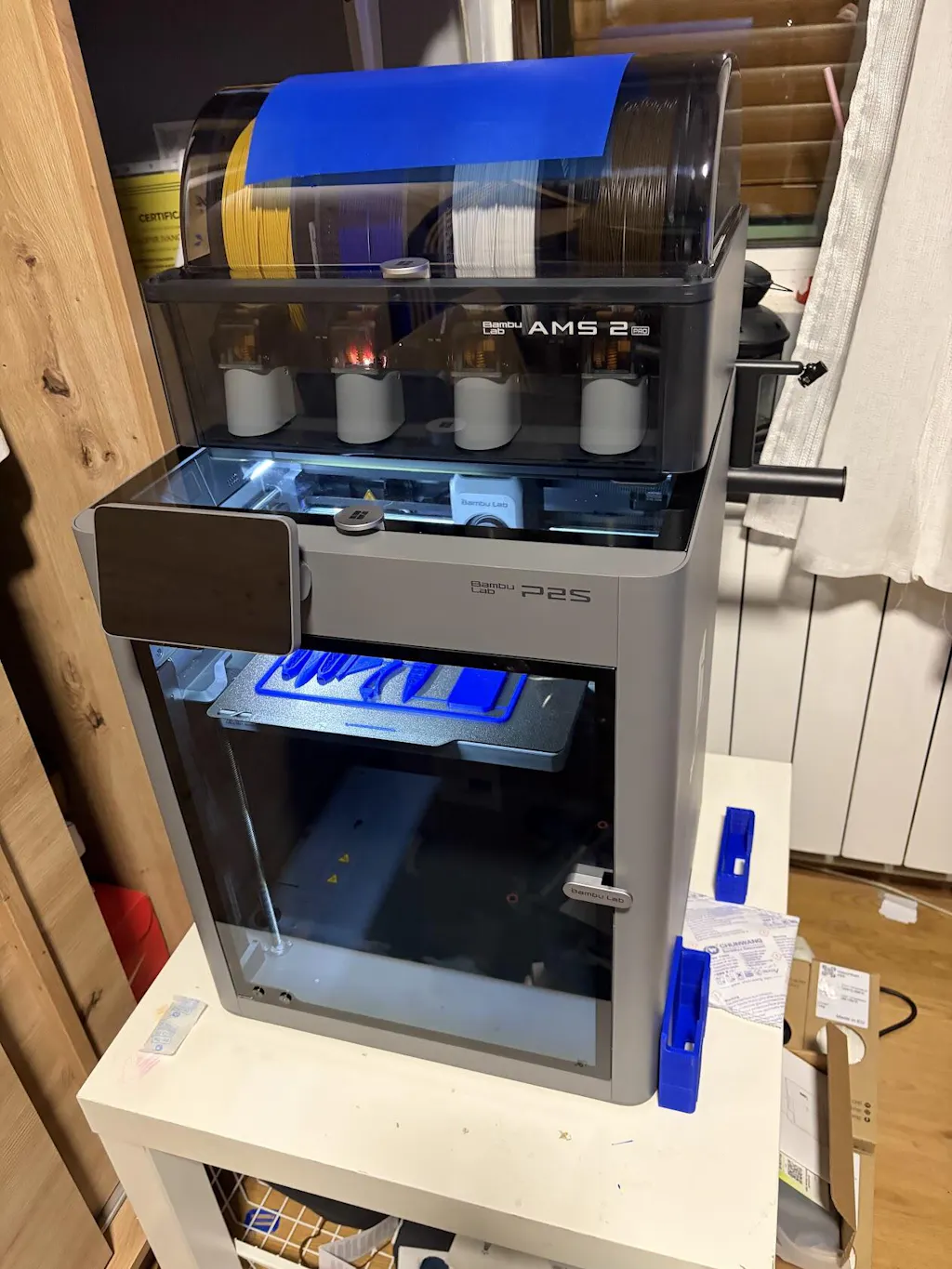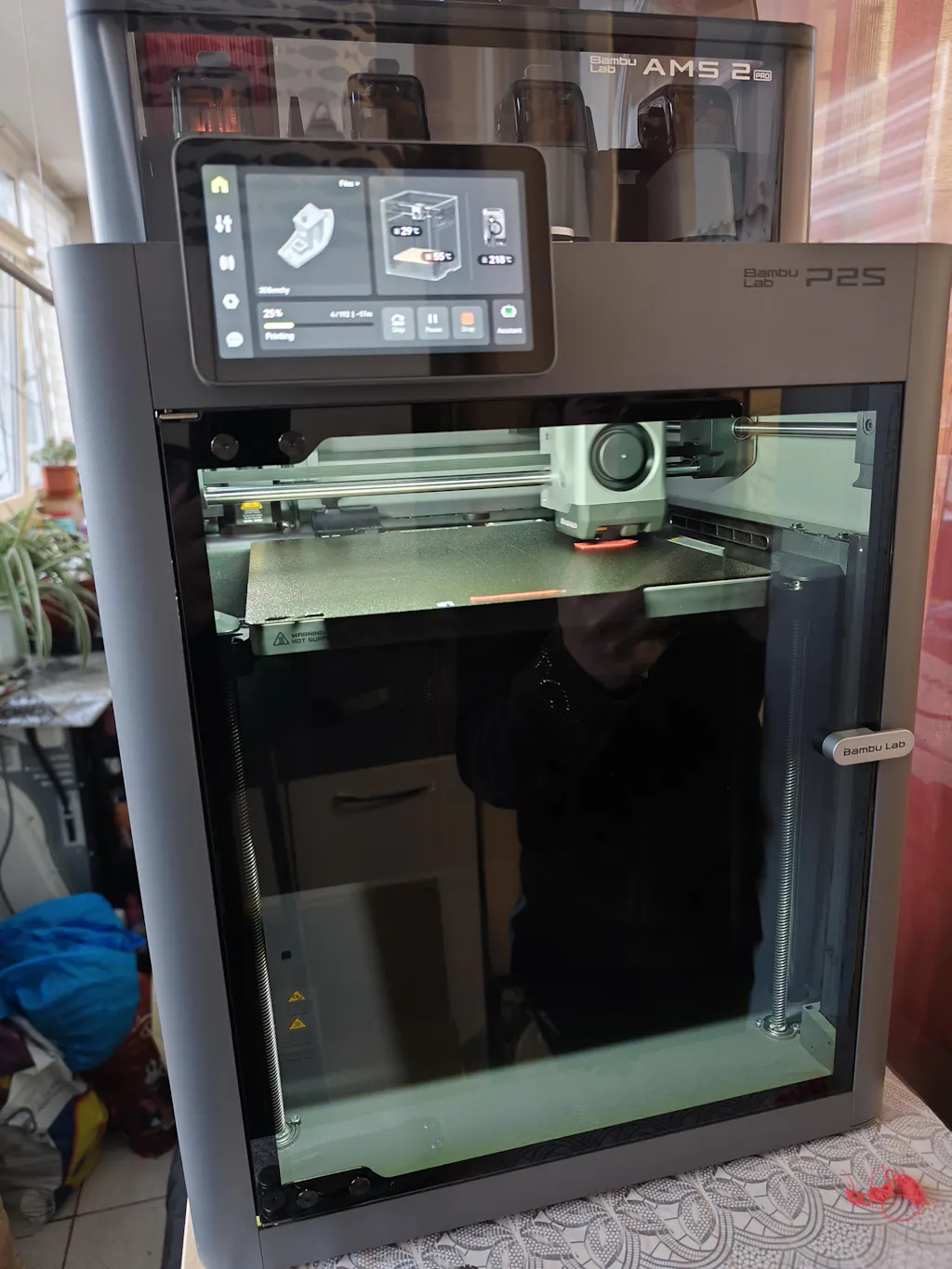



Bambu Lab P2S Combo – CoreXY 3D printer with AMS 2 Pro for multicolour 3D printing
Bambu Lab P2S Combo combines the reliable enclosed CoreXY printer P2S and the intelligent material system AMS 2 Pro in a ready-to-use kit for fast, clean, and multicolour printing. The volume of 256 × 256 × 256 mm covers everyday engineering and design tasks, while the new PMSM servo-driven extruder provides up to 8.5 kg of force for stable high-flow printing. The model also features a 5" touchscreen, 1080p camera for monitoring, and AI error checks – functions inherited from Bambu's higher class.
The combo includes AMS 2 Pro – a 4-position automatic material/colour change system with drying up to 65 °C and the ability to expand to 24 colours through cascading additional modules. This significantly speeds up work and increases reliability with sensitive materials.
Technology and quality
P2S is a FFF/FDM 3D printer with CoreXY kinematics, which provides high speed and smooth movements. The official specification sheet states a max. print head speed of 600 mm/s, acceleration of 20,000 mm/s², and max. flow rate of 40 mm³/s with the standard hotend – parameters that allow for rapid prototyping without compromising geometric accuracy. In real conditions, the recommended "standard" speeds are lower for optimal quality, but the "Sport/Ludicrous" modes offer an option for drafts.
The hotend and nozzle are made of hardened steel for reliable printing with abrasive composite filaments; the supported nozzle diameters are 0.2/0.4/0.6/0.8 mm, and the maximum temperature is 300 °C. The bed reaches 110 °C and uses a flexible steel plate with PEI for easy part removal.
The new servo-driven extruder (PMSM) increases the extrusion force by ~70% compared to the previous generation and operates with an eddy current sensor for dynamic flow calibration – the system automatically compensates for the pressure in the nozzle for even layers.
The camera is 1920×1080@30 fps, and the air filter with granulated activated carbon (coconut shell) reduces VOCs and dust particles in the enclosed chamber. Important: P2S does not have an actively heated chamber; it maintains controlled airflow and primarily relies on the heated bed and Adaptive Airflow for materials like ABS/ASA.
Performance and workflow
- Print volume: 256 × 256 × 256 mm; machine dimensions: 392 × 406 × 478 mm.
- Speed and acceleration: up to 600 mm/s and 20,000 mm/s² (draft print modes available).
- Automations: auto-levelling, recovery after power loss, detection of tangling/running out of filament, AI monitoring of the print.
- File formats in Bambu Studio: 3MF, STL, OBJ, AMF, STEP/STP. It also supports third-party slicers with standard G‑code (some advanced features may be missing).
- Connectivity and control: dual-band Wi‑Fi (2.4/5 GHz), USB; control from a 5" touchscreen, mobile, and web application.
AMS 2 Pro adds seamless material/colour switching with automatic recognition (RFID), active drying up to 65 °C, and the ability to handle up to 24 materials through expansion – key for complex prototypes and time-saving.
Compatibility, software, and ecosystem
P2S operates on Windows, macOS, and Linux, with the best integration achieved with Bambu Studio and the MakerWorld cloud. If needed, PrusaSlicer/SuperSlicer/Cura can be used (exporting standard G‑code), but some specific features of the Bambu ecosystem may be missing. For TPU, it is recommended to feed from the external spool (outside of AMS).
The AMS 2 Pro system is designed as a dry box: a hermetic enclosure, humidity control, and active ventilation for drying – critical for nylon/PC/PA‑CF. With a series of connections to the AMS modules, printing with multiple materials is achieved without manual intervention.
Internal resources for assistance: 3D printer category, composite filaments.
Design, ergonomics, and safety
Enclosed chassis with impact-resistant front glass, integrated handles, and a flat bottom for easy cleaning. The new 5” touchscreen makes control intuitive, while the 1080p camera provides clear time-lapses and remote control. The activated carbon filter and adaptive airflow improve quality and safety when printing technical materials. Note: there is no active heated chamber; for ABS/ASA keep doors closed and minimize drafts.
Professional scenarios
- Production fixtures and rail/jigs: sturdy parts made of PETG/ABS for assembly lines; stable quality at high speed thanks to CoreXY and servo-driven extruder.
- Engineering prototypes: housings and clips with precise assembly; automatic flow calibration improves dimensional repeatability.
- Multicolour demonstration models: logos, panels, and functional prototypes with up to 4 colours (with 1× AMS) and expandable to 24 – without manual change.
- Education/lab: rapid production of educational models; the chamber and AI monitoring facilitate oversight and safety.
- Flexible materials: TPU from external spool (outside AMS) for cases and dampers.
Limitations, best practices, and technical specifications
Limitations and tips:
- ABS/ASA without active chamber: use a closed door, adhesive/glue spray, moderate speeds, and high bed temperature; allow the printer to stabilize the temperature.
- Multicolour printing: expect waste when changing colour; optimize flush volume in the slicer and group colours for less cleaning. (Summary of practices from reviews/community.)
- TPU/soft filament: feed from outside AMS; reduce speed/retractions.
| Technical Specifications – Bambu Lab P2S | |
|---|---|
| Technology | FFF/FDM, CoreXY |
| Print Volume | 256 × 256 × 256 mm |
| Max. Print Head Speed | 600 mm/s |
| Acceleration | 20,000 mm/s² |
| Max. Flow Rate (standard hotend) | 40 mm³/s |
| Machine Dimensions (W×D×H) | 392 × 406 × 478 mm |
| Weight (net) | 14.9 kg |
| Filament Diameter | 1.75 mm |
| Nozzle Temperature | up to 300 °C |
| Bed Temperature | up to 110 °C |
| Nozzles | 0.4 mm included; supports 0.2/0.6/0.8 mm (hardened steel) |
| Camera | 1080p @ 30 fps |
| Display | 5″, 854 × 480 px, touch |
| Connectivity | Wi‑Fi 2.4/5 GHz, USB |
| OS | Windows, macOS, Linux |
| File Formats | 3MF, STL, OBJ, AMF, STEP/STP |
| Sensors | door, run‑out, tangle, odometry (with AMS), recovery after power failure |
| Filtration | activated carbon (coconut shell) |
| Power Supply | 100–120 V / 200–240 V, 50/60 Hz; max. 1200 W @ 220 V |
AMS 2 Pro (highlights): 4 spools, drying up to 65 °C, airtight storage, RFID profiles, expandable to 24 materials (with additional modules). Dimensions: 372 × 280 × 226 mm; weight ~2.5 kg.